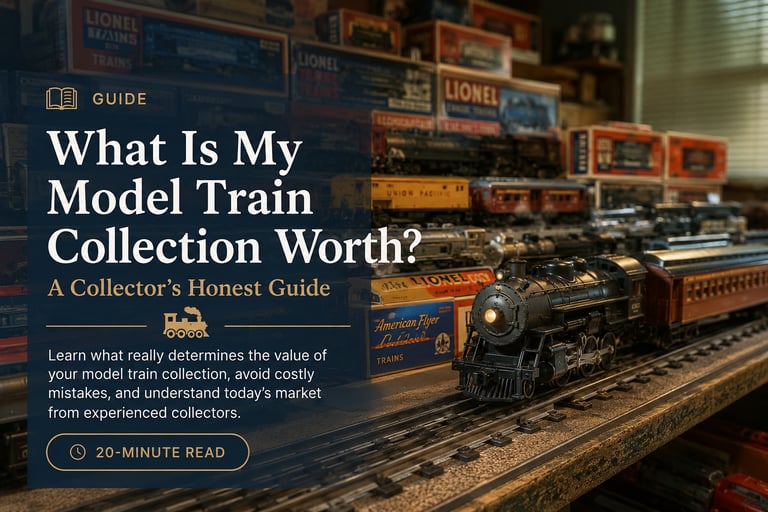
What Is My Model Train Worth?
Learn what really determines the value of your model train collection, avoid costly mistakes, and understand today's collector market.
5/13/1926
PART 1: Understanding Model Train Values
A Collector's Honest Guide from East Coast Train Buyers
If you've recently inherited a model train collection, are thinking about selling one you've owned for years, or are simply curious what it's worth, you're not alone.
One of the first questions we hear at East Coast Train Buyers is:
"What is my model train collection worth?"
It's a fair question—but it's also one of the hardest to answer.
After decades of collecting, buying, selling, and evaluating model train collections, we've learned that there's no simple formula. We've seen two collections that looked almost identical at first glance, yet one was worth several times more than the other. We've also seen collections that owners believed were worth a fortune turn out to be quite ordinary, while a single overlooked locomotive or freight car ended up being the most valuable item in the room.
Whether your collection includes Lionel, American Flyer, Marx, MTH, HO, N Scale, brass models, or a mixture of brands and scales, the same basic principles apply.
The good news is that you don't need to become an expert collector to understand what drives value. By the end of this guide, you'll know what experienced buyers look for, the mistakes that cost sellers money, and why the answer is often very different from what people expect.
The Quick Answer
If you're looking for the short version, here it is.
A model train collection is worth whatever knowledgeable collectors are willing to pay for it in today's market.
Not what someone paid for it.
Not what an old price guide says.
Not what someone is asking on eBay.
Its value depends on several important factors, including:
Overall condition
Collector demand
Brand and manufacturer
Rarity and desirability
Completeness of sets
Original boxes and paperwork
Whether modern electronic features work properly
Current market conditions
That may sound like a lot to consider, but don't worry. We'll explain each of these factors as we go.
Why There Isn't a Simple Price Guide
One of the biggest misconceptions people have is that every train has a fixed value.
Unfortunately, it doesn't work that way.
Imagine two identical Lionel steam locomotives sitting side by side.
One has its original box, has been carefully stored, runs perfectly, and still has all of its original paint and parts.
The other spent years in a damp basement, has rust, missing parts, and no longer runs.
Even though they're the same model, they may have dramatically different values.
Now multiply that by an entire collection.
That's why we prefer to evaluate collections in person whenever possible. At the very least, we like to see a detailed inventory and clear photographs. A single photo of a table full of trains rarely tells the whole story.
Five Myths We Hear All the Time
Over the years we've heard just about every misconception imaginable. Here are the ones we hear most often.
Myth #1: "If it's old, it must be valuable."
This is probably the biggest misconception of all.
Older doesn't automatically mean more valuable.
In fact, we've seen train sets from the 1950s and 1960s sell for more than some trains from the 1930s.
Age is only one piece of the puzzle. Condition, desirability, and current collector demand matter much more.
Myth #2: "It's made of metal, so it's worth a fortune."
Many people assume that heavy die-cast metal trains are automatically valuable.
Some certainly are.
Many are not.
Over the years, manufacturers produced millions of trains. Some models are genuinely scarce and highly sought after. Others were made in such large numbers that they're still fairly common today.
Being made of metal doesn't guarantee high value.
Myth #3: "I saw one on eBay for $500."
This is a conversation we have almost every week.
Seller: "I found my locomotive on eBay for $500."
Our response: "Was that the asking price—or what it actually sold for?"
Anyone can ask any price they want.
The only prices that matter are completed sales because those represent what real buyers were actually willing to pay.
Professional buyers, experienced collectors, and auction companies all rely on sold prices—not listings that may never sell.
Myth #4: "An old price guide tells me what it's worth."
Price guides can be useful for identifying trains, but they're only snapshots of the market at a particular moment in time.
The model train market changes.
Some trains become more desirable.
Others become less so.
A value printed twenty years ago may have little relationship to today's market.
Current demand—not yesterday's price guide—determines today's value.
Myth #5: "My friend says it's worth..."
We've met many wonderful people over the years, and almost everyone has a friend, neighbor, or relative who "knows trains."
Sometimes they do.
Often they don't.
Well-meaning advice can create unrealistic expectations, especially if it's based on memories from decades ago or information found online without understanding today's market.
Whenever possible, it's worth getting an opinion from someone who actively buys, sells, and follows the collector market on a regular basis.
Why the Market Has Changed
One of the questions we hear most often is:
"Why doesn't my collection bring what it would have twenty-five years ago?"
The answer isn't that your trains became less interesting.
The market changed.
During the 1990s and early 2000s, many collectors who had grown up with trains in the 1940s, 1950s, and 1960s were in their prime collecting years. Demand was strong, and prices reflected that enthusiasm.
Today, many of those same collectors are downsizing or their families are selling lifelong collections. As more collections come onto the market, supply has increased.
At the same time, younger collectors often have different interests.
Many HO and N Scale enthusiasts are looking for locomotives equipped with DCC, digital sound, and advanced operating features they can control from a smartphone or modern control system.
Older collectors often enjoy repairing and maintaining traditional mechanical trains. Many younger buyers expect everything to work right out of the box and are less interested in repairing complex electronics.
That's one reason modern electronic locomotives can lose value quickly if their features can't be demonstrated. Buyers know that replacement parts and electronic components may become difficult—or impossible—to find after only a few years.
In other words, not every train follows the same value curve.
Understanding today's market is just as important as understanding yesterday's history.
PART 2: How Experienced Collectors Determine Value
Before we start assigning values, we'd like to make one thing clear.
When someone contacts East Coast Train Buyers and asks, "What is my collection worth?", we don't immediately start quoting prices.
Instead, we start asking questions.
Can we see the collection in person?
If not, can you provide a complete inventory and clear photographs?
Is the collection primarily Lionel, American Flyer, HO, N Scale, or a mixture of different brands and scales?
Has it been stored in a dry environment?
Does everything appear to be complete?
These questions help us understand the collection before we ever discuss value.
No experienced collector can accurately appraise an entire collection from one blurry photograph or a brief description over the phone. Every collection deserves to be evaluated on its own merits.
The Three Factors That Matter Most
After evaluating hundreds of collections over the years, we've found that three factors influence value more than almost anything else.
1. Condition
If we could teach someone only one thing about model train values, it would be this:
Condition is king.
We've seen common trains in outstanding condition sell for more than much rarer trains in poor condition.
When we evaluate a collection, we're looking for things like:
Original paint and lettering
Rust or corrosion
Missing parts
Cracked castings or plastic
Broken handrails or ladders
Evidence of repairs or repainting
Clean wheels and pickups
Signs of water damage or improper storage
Condition also includes functionality.
Does the locomotive run?
Do the lights work?
If it's equipped with digital sound, does it function properly?
Can all the electronic features be demonstrated?
For modern locomotives, these questions become especially important.
A locomotive with fully functioning DCC, sound, smoke, lighting, and remote-control features is far more desirable than one that cannot be tested or has electronic problems.
🚂 Ken's Collector's Insight
"I've had people tell me, 'It's been in the attic for fifty years, so it must be mint.' Unfortunately, that's not always the case. Time alone doesn't preserve a train. How it was stored makes all the difference."
2. Desirability Is More Important Than Rarity
This surprises many people.
We often hear,
"But it's rare."
Our next question is:
"Rare to whom?"
Rarity by itself doesn't guarantee value.
A train can be rare simply because very few were made.
But if very few collectors want it, rarity doesn't automatically create demand.
On the other hand, some locomotives that were produced in relatively large numbers remain highly desirable because collectors actively seek them.
That's why we prefer to think in terms of desirability, not just rarity.
The market ultimately decides what collectors are willing to pay.
3. Complete Sets Usually Bring More Interest
Many sellers naturally focus on the locomotive.
Sometimes, however, the locomotive isn't the rarest part of the set.
We've evaluated collections where one freight car, caboose, accessory, or original transformer was actually harder to replace than the engine itself.
Keeping original sets together often preserves both historical integrity and market appeal.
Likewise, original instruction sheets, paperwork, catalogs, and especially the original boxes can add meaningful value to many collections.
Boxes don't automatically double the price—but they often make a collection much more attractive to collectors because they demonstrate careful ownership and improve long-term collectibility.
Brand Matters More Than Many People Realize
To someone unfamiliar with model trains, two locomotives may look almost identical.
An experienced collector knows that appearances can be deceiving.
The manufacturer often plays a significant role in determining value.
For example, in the HO market, two similar locomotives may have very different values simply because one was produced by a manufacturer known for higher quality, better detailing, or more advanced electronics.
Likewise, within O gauge, different manufacturers have earned different reputations over the years.
That's one reason we never recommend judging value based solely on appearance.
Knowing who made the train is just as important as knowing what the train looks like.
🚂 Josh's Market Insight
"One of the first things I notice is the locomotives. In today's HO market, I'm immediately looking to see whether they're equipped with DCC and sound or traditional DC. Modern buyers expect those features, and they can make a significant difference in value."
Modern Technology Has Changed the Market
Technology has transformed the hobby.
Many younger collectors enjoy operating layouts with digital command systems, synchronized sound, realistic lighting, and smartphone control.
Those features can increase the desirability of modern locomotives—provided everything works.
Unfortunately, electronics introduce another challenge.
Unlike traditional mechanical locomotives that can often be repaired decades later, some electronic components become difficult to replace after only a few years.
Manufacturers discontinue parts.
Circuit boards become obsolete.
Repair specialists become harder to find.
As a result, buyers are understandably cautious when evaluating modern electronic equipment.
If every function works, that's a tremendous advantage.
If those features can't be demonstrated, buyers must often assume they'll be purchasing a repair project.
That uncertainty usually reduces value.
Why We Prefer to See Collections in Person
One of the questions we're frequently asked is:
"Can't you tell me what it's's worth from a few pictures?"
Sometimes we can provide a rough idea.
But photographs rarely tell the whole story.
We've learned that there are many details you simply can't evaluate through a phone screen.
Is the paint original?
Has the locomotive been repaired?
Do all the functions work?
Are the boxes complete and in good condition?
Are there missing pieces tucked away in another box?
When possible, we prefer to examine collections in person.
That allows us to evaluate them the same way another experienced collector would—and ultimately results in a much more accurate assessment.
PART 3: What We've Learned After Evaluating Hundreds of Collections
There are some lessons you simply can't learn from reading price guides or browsing auction results online.
They come from walking into homes, opening boxes that haven't been touched in decades, listening to family stories, and evaluating hundreds of collections over many years.
Some collections have exceeded every expectation.
Others have reminded us that sentimental value and market value aren't always the same thing.
And almost every collection has taught us something.
Here are some of the lessons we've learned.
Every Collection Has a Surprise
One of the things we enjoy most about evaluating collections is that no two are ever exactly alike.
We've walked into homes expecting to see a few common trains and discovered an exceptionally rare locomotive tucked away in the bottom of a box.
We've seen collections that owners believed were worth a small fortune because of something they found online, only to discover those prices were asking prices—not actual selling prices.
We've also found valuable freight cars, accessories, transformers, or original boxes that the owners never realized added meaningful value to the collection.
The opposite happens too.
Sometimes a room full of trains looks impressive at first glance, but after a closer look, most of the pieces are common production items that are readily available in today's market.
That's why experienced buyers never judge a collection by first impressions alone.
The Biggest Mistakes Sellers Make
Fortunately, most mistakes can be avoided once you understand how collectors think.
Mistake #1: Cleaning Trains Before They're Evaluated
This surprises many people.
It's natural to want to clean something before showing it to a potential buyer.
But aggressive cleaning, polishing, repainting, or replacing original parts can actually reduce collector value.
Collectors generally prefer honest, original condition over a train that has been "improved" incorrectly.
If you're unsure whether something should be cleaned, it's usually best to leave it exactly as it is until someone experienced has looked at it.
Mistake #2: Trusting Outdated Price Guides
Many price guides were excellent resources when they were published.
The problem is that markets don't stand still.
We've met families who were relying on books printed twenty or thirty years ago.
Unfortunately, those values often reflect a market that no longer exists.
Current collector demand—not an old book—determines today's prices.
Mistake #3: Listening to Well-Meaning Friends and Relatives
Almost everyone knows someone who says,
"Oh, those old trains are worth thousands."
Sometimes they're right.
More often, they're repeating something they heard years ago.
Unless someone actively follows today's collector market, buys collections regularly, or attends train shows, their opinion may be based on outdated information.
Mistake #4: Expecting Used Trains to Sell for New Prices
Josh sees this regularly.
Someone purchased a locomotive years ago for several hundred dollars and assumes it should still be worth at least that much today.
Sometimes that happens.
Often it doesn't.
Like many collectibles, model trains follow the market.
Some appreciate.
Some remain relatively stable.
Others decline in value as technology changes or collector interests evolve.
The original purchase price doesn't determine today's value.
The market does.
🚂 Josh's Market Insight
"One thing I see quite often is someone expecting to sell a used train for what they paid when it was new. Unfortunately, that's not how the market works. The value today depends on what collectors are willing to pay today—not what the receipt said years ago."
Sentimental Value and Market Value Are Different
This can be one of the most emotional parts of selling a collection.
We've heard countless stories like:
"Dad bought this locomotive when I was a child."
"Every Christmas we set this train up around the tree."
"Grandpa spent years building this layout."
Those memories are priceless.
But they don't necessarily increase the market value of the trains themselves.
That's why we always encourage families to think carefully before selling everything.
Sometimes the most meaningful locomotive isn't the most valuable one.
Keeping one or two special pieces can preserve decades of family memories while allowing the rest of the collection to find new homes.
🚂 Ken's Collector's Insight
"There have been many times when we've encouraged people to keep a train instead of selling it. If it's the locomotive Dad ran every Christmas or the set Grandpa gave the grandchildren, that memory may be worth more than anything we could pay for it."
Sometimes the Best Decision Is Not to Sell Everything
This may surprise you.
As buyers, you might assume we always encourage people to sell their entire collection.
That's simply not true.
There have been many occasions when we've suggested:
Keeping Dad's favorite locomotive.
Saving the family's Christmas train.
Passing a special set down to children or grandchildren.
Selling the common items while preserving the meaningful ones.
We believe every family should make the decision that's right for them—not the decision that's best for us.
Ironically, that's one of the reasons many people decide to work with us.
They know they're receiving honest advice instead of sales pressure.
Why We Love This Hobby
People sometimes ask us what keeps us interested after all these years.
The answer has very little to do with buying trains.
For Ken, it's preserving collections that might otherwise be forgotten. He enjoys bringing neglected locomotives back to life, restoring them to operating condition, and knowing they'll continue to be appreciated by future collectors.
For Josh, it's helping trains find the right home. There's genuine satisfaction in placing a locomotive with someone who's been searching for that exact model or helping a family understand the collection they've inherited. Meeting collectors, buyers, and sellers at train shows and sharing the hobby is just as rewarding as making a purchase.
In many ways, we're simply caretakers.
Every collection belonged to someone before us.
Every collection will belong to someone after us.
Our goal is to help make that transition with honesty, respect, and an appreciation for the history behind every train.
PART 4: Frequently Asked Questions and Final Thoughts
By now, you probably have a much better understanding of what influences the value of a model train collection.
Before we finish, we'd like to answer a few of the questions we hear most often.
Frequently Asked Questions
Can you tell me what my collection is worth from photographs?
Sometimes we can provide a general opinion, but photographs rarely tell the whole story.
Pictures don't reveal whether a locomotive runs properly, whether electronics function as they should, whether parts have been replaced, or whether subtle condition issues exist.
Whenever possible, we prefer to evaluate collections in person. If that's not practical, a detailed inventory and clear photographs from several angles are the next best thing.
Do original boxes really make a difference?
Often, yes.
Original boxes, instruction sheets, catalogs, and paperwork demonstrate that a collection has usually been well cared for. They also make individual pieces more attractive to collectors.
Boxes don't automatically double the value, but they can certainly make a collection more desirable and easier to sell.
Should I separate my collection before selling it?
In most cases, we recommend leaving the collection together until someone experienced has evaluated it.
Sometimes a complete set is worth more than the individual pieces.
Other times, a mixed collection containing Lionel, American Flyer, HO, N Scale, and other brands may benefit from being grouped by scale or manufacturer before selling.
Every collection is different, which is why we don't believe in one-size-fits-all advice.
Should I clean my trains before having them evaluated?
Generally, no.
Dust can usually be removed safely, but polishing, repainting, replacing parts, or attempting repairs without understanding collector preferences can reduce value.
If you're unsure, it's usually best to leave everything exactly as you found it until it has been evaluated.
Are all old trains valuable?
No.
Age alone doesn't determine value.
We've seen relatively common trains from the 1950s sell for more than certain trains from the 1930s, while some modern locomotives equipped with advanced electronics remain highly desirable because collectors actively want them.
The market rewards condition, desirability, completeness, and demand—not simply age.
What brands do you evaluate?
Nearly every major model train manufacturer.
That includes Lionel, American Flyer, Marx, MTH, K-Line, Williams, Atlas O, Weaver, Bachmann, Athearn, Broadway Limited, Bowser, Walthers, brass imports, and many others.
We also evaluate collections in O gauge, S gauge, Standard Gauge, HO, N Scale, G Scale, and mixed collections.
Whether you have ten trains or several hundred, we're happy to help you better understand what you have.
Why Families Trust East Coast Train Buyers
There are many places you can sell model trains.
There are auction houses.
Online marketplaces.
Train shows.
Consignment dealers.
Private collectors.
And there are companies like ours.
What we hope sets East Coast Train Buyers apart isn't simply that we buy collections.
It's how we approach them.
Ken has been involved with Lionel trains since childhood. His father was a seasonal Lionel dealer, and Ken has been collecting since he was 12 years old. Today, he has more than 50 years as a member of the Train Collectors Association and attends 25 to 30 train shows throughout the Eastern Seaboard each year.
Josh brings the perspective of today's active collector and buyer. He works with modern brands, understands current market trends, and spends countless hours buying, selling, and talking with collectors at train shows. His experience with today's HO, N Scale, and modern O gauge market complements Ken's decades of historical knowledge.
Together, we've evaluated collections of every size—from a single box stored in a closet to lifelong collections filling an entire basement.
Perhaps more importantly, we understand that these aren't just trains.
They're family memories.
They're Christmas mornings.
They're weekends spent building layouts with children and grandchildren.
They're a lifetime of collecting.
That perspective influences every conversation we have.
🚂 Our Philosophy
Over the years, we've discovered something important.
The best outcome isn't always buying a collection.
Sometimes it's helping a family understand what they have.
Sometimes it's encouraging someone to keep Dad's favorite locomotive.
Sometimes it's explaining why an old price guide no longer reflects today's market.
And sometimes it's simply giving someone enough information to make the decision that's right for them.
If, after reading this guide, you have a better understanding of your collection—even if you never sell a single train to us—we've accomplished exactly what we hoped to do.
Our Final Thoughts
If there's one thing we'd like you to remember, it's this:
Every model train collection has two values.
The first is its market value—what knowledgeable collectors are willing to pay today.
The second is its personal value—the memories attached to it.
Those two values are rarely the same.
Neither is wrong.
One can be measured in dollars.
The other cannot.
Before making any decisions, take a little time to appreciate the stories behind the collection.
Decide whether there are a few special pieces you'd like to keep.
Then, if you'd like an honest opinion about the rest, we'd be happy to help.
Whether your collection contains Lionel, American Flyer, Marx, MTH, HO, N Scale, brass models, or a little bit of everything, we'll evaluate it the same way we'd evaluate a collection belonging to our own family—with honesty, respect, and a genuine appreciation for the hobby.
Because in the end, we're collectors first.
Buying collections is simply one part of what we do.
Helping preserve the hobby is what we care about most.
Before You Sell Your Collection
☐ Don't clean anything.
☐ Gather the original boxes.
☐ Photograph everything.
☐ Keep complete sets together.
☐ Don't rely on asking prices.
☐ Don't rely on old price guides.
☐ Decide if there are sentimental items you'd like to keep.
☐ Get an opinion from someone who knows today's market.
Ready to Learn What Your Collection Is Worth?
If you'd like us to evaluate your collection, we're always happy to have a conversation.
There is no pressure and no obligation.
We'll answer your questions honestly, explain how we arrived at our opinion, and help you understand today's market so you can decide what makes the most sense for you and your family.
Whether you ultimately sell to us, choose another option, or decide to keep your trains, our goal is the same:
To help you make an informed decision.
East Coast Train Buyers
We're collectors helping collectors and families sell model train collections honestly, fairly, and with as little hassle as possible.
Explore
Get in Touch
Seasonal hubs in NY & SC
We travel to you across the East Coast
© 2026 East Coast Train Buyers
Over 50 years of model railroading experience.
TCA Members & Officers